Vertical Column Widget
Charts help you visualize your data and gain insights. The Vertical Column Widget lets you customize colors, apply Formula, choose whether groups are stacked, and more.
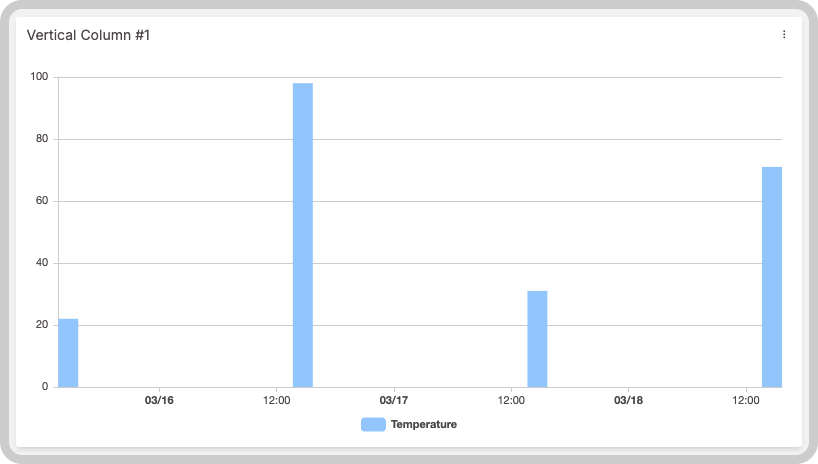
This widget also supports features such as metadata and groups, which can be set in your variable data.
1. 'Data Sources' Field
This field allows you to set the device and variable that will be used by the widget.
Editing options for the selected variable
- Click on the settings icon to edit specific options such as formulas, color, and more.
- Click on the close icon to remove this variable from the widget's data.
The available variables depend on the type of dashboard you are using; the difference is explained below.
1.1 Data Sources for Normal Dashboards
From the option 'Data Sources' in the right‑hand menu, select one device from your list and then choose the variable that contains the data.
1.2 Data Sources for Blueprint Dashboards
From the option 'Data Sources' in the right‑hand menu, add the Blueprint device and input the name of the variable that contains the information. When using a Blueprint dashboard, the field Variable will list variables to be picked using the currently selected blueprint device.
2. Composing X-axis and Y-axis
In the vertical column chart widget you can customize how data is displayed on both axes.
2.1 X‑axis
By default, the X‑axis shows the time of each value, and you can set a custom time range. If you need to group data that does not share the same timestamp, select a variable that contains the grouping key; all values will then be grouped by groups.
Data is ordered by time ascending by default, but it can also be sorted by groups.
You can define the X‑axis time range dynamically using another variable. The payload should look like this:
{
  "variable": "time_range",
  "value": "Any value",
  "metadata": {
    "start_date": "2021-06-17T00:00:00.000Z",
    "end_date": "2021-06-18T00:00:00.000Z"
  }
}
The start_date specifies the start of the range, and the end_date specifies the end. Both dates must be in ISO 8601 format.
2.2 Y‑axis
You can customize the scaling behavior on the vertical axis, apply metric prefixes or abbreviations, change the step value (the difference between each tick), and more. The Y‑axis will automatically find the best scale for your data; manual adjustments are only needed if you have specific requirements.
3. Filtering data
You can pre‑set date filters to be displayed on the chart. Filters can be set in minutes, hours, days, weeks, months, or custom by choosing a date from the calendar.
4. Increasing performance
For charts with a large number of data points, enable the Aggregate feature to improve widget performance and make the data easier to visualize. Learn more about the Aggregate feature.